
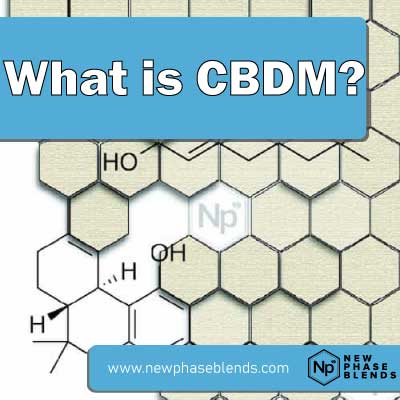
Cannabis chemistry is full of methylated surprises. While CBD is defined by its two free hydroxyl groups on its resorcinol ring, nature has also produced versions with one or both of those groups capped with a methyl group. CBDM — cannabidiol monomethyl ether, or CBD-2′-monomethyl ether — is the one-methyl version: a naturally occurring minor cannabinoid that exists in cannabis and has a measurably different pharmacological profile from the compound it’s derived from.
CBDM occupies an interesting middle position in the CBD methylation series — more potent than CBD as a 15-lipoxygenase inhibitor, less potent than its fully dimethylated cousin CBDD. It also appears to share CBD’s sedative-potentiating properties, shows early evidence of anti-allergy and anti-inflammatory activity, and metabolizes via cytochrome P450 through a distinct pathway. For a compound with very few dedicated studies, there is surprisingly much to say about it (Takeda et al., 2009; ScienceDirect Topics, 2024).
What Is CBDM?
CBDM is the abbreviation for cannabidiol-2′-monomethyl ether — a naturally occurring phytocannabinoid in Cannabis sativa and one of the six recognized natural CBD derivatives. It is structurally identical to CBD except that one of the two hydroxyl (–OH) groups on the resorcinol ring has been replaced by a methoxy group (–OCH₃) through a process called O-methylation (ScienceDirect Topics, 2024).
CBDM has been isolated from multiple cannabis sources, including the domestic Japanese hemp cultivar ‘Minamioshihara No. 1’ and the Italian medicinal cannabis variety FM2, where it has been detected and distinguished from structural isomers by high-resolution mass spectrometry (Linciano et al., 2020; New Phase Blends, 2023).
Also known as: CBDM, CBDM-C5
Molecular Formula: C₂₂H₃₂O₂
Classification: Natural CBD derivative / O-methylated cannabinoid
Key modification: One hydroxyl group on resorcinol ring methylated
Psychoactive: No
Primary known mechanisms: 15-LOX inhibition, CYP1A1 inhibition, sedative potentiation
Consumer availability: Research use only
CBDM vs. CBD: Key Differences
The single O-methylation of CBD produces a compound that is not merely a weaker version of CBD, but one with a distinct pharmacological fingerprint. The hydroxyl groups on CBD’s resorcinol ring are key to several of its interactions — and when one is capped, the compound’s binding behavior, enzyme interactions, and metabolic pathway all shift (Takeda et al., 2009).
| Property | CBDM | CBD |
|---|---|---|
| Resorcinol methylation | One –OH methylated (mono) | No methylation (free –OH groups) |
| 15-LOX IC₅₀ | Lower than CBD (more potent) | 2.56 μM |
| CYP1A1 inhibition | Enhanced vs. CBD | Moderate |
| Sedative potentiation | Yes (prolongs pentobarbital sleep) | Yes (prolongs pentobarbital sleep) |
| Psychoactive | No evidence | No |
| Metabolic pathway | CYP P450 → cannabielsoin monomethyl ether (CBEM) | CYP P450 → cannabielsoin (CBE) |
| Natural abundance | Trace | Major cannabinoid |
| Research volume | Very limited | Extensive |
The Methylation Series: CBDM, CBDD, and CBD
Understanding CBDM is easiest in the context of the CBD methylation series. CBD has two free hydroxyl groups on its resorcinol ring. Methylating one produces CBDM. Methylating both produces CBDD (cannabidiol dimethyl ether). Research by Takeda et al. (2009) established a clear structure-activity relationship across this series for 15-lipoxygenase (15-LOX) inhibition:
- CBD: IC₅₀ of 2.56 μM against 15-LOX
- CBDM (one methyl group): More potent than CBD
- CBDD (two methyl groups): Most potent of the three, with an IC₅₀ of 0.28 μM — approximately nine times more potent than CBD
This stepwise relationship demonstrates that the number of methyl groups on the resorcinol ring is a key pharmacophoric determinant for 15-LOX inhibitory potency — a finding with broader implications for how structural modifications to CBD affect its enzyme interactions (Takeda et al., 2009).
How CBDM Works in the Body
15-Lipoxygenase (15-LOX) Inhibition
CBDM’s most studied mechanism is its inhibition of 15-lipoxygenase (15-LOX), an enzyme involved in oxidizing fatty acids including those in LDL (“bad cholesterol”) particles. 15-LOX-mediated oxidation of LDL produces oxidized LDL (ox-LDL), a central driver of atherosclerosis. By inhibiting 15-LOX more potently than CBD, CBDM belongs to a class of CBD methylation derivatives with potential cardiovascular protective relevance (Takeda et al., 2009; ScienceDirect Topics, 2024).
CYP1A1 Inhibition
CBDM and its fully methylated relative CBDD both enhance inhibition of cytochrome P450 1A1 (CYP1A1) activity — an enzyme involved in the metabolism of polycyclic aromatic hydrocarbons and certain carcinogens, as well as some pharmaceutical drugs. CYP1A1 is expressed in the liver and other tissues and plays roles in both carcinogen activation and detoxification depending on context (ScienceDirect Topics, 2024).
Sedative Potentiation
In animal pharmacology studies, CBDM has been shown to prolong pentobarbital-induced sleep in mice — an effect shared with CBD itself and with the CBDM metabolite cannabielsoin monomethyl ether (CBEM). This sedative-potentiating property suggests CBDM may enhance CNS depressant effects, though the mechanism is not fully characterized (Gohda et al., 1990, as cited in ScienceDirect Topics, 2024).
Anti-Allergy and Anti-Inflammatory Properties
Preliminary evidence suggests CBDM may have anti-allergy properties, potentially through inhibition of inflammatory substances involved in allergic and inflammatory pathways. Cannabidiol monomethyl ether has been identified as a potential candidate for further investigation as an anti-allergy therapy, though this is based on limited and uncorroborated early research (Secret Nature, 2026). General anti-inflammatory activity is also inferred from its 15-LOX inhibitory profile and its structural relatedness to CBD.
What the Research Says
Metabolism Studies (Guinea Pig)
The most detailed pharmacological study of CBDM examined its oxidative metabolism in guinea pigs in vivo and in vitro. Researchers found that CBDM is metabolized by the hepatic monooxygenase system — specifically cytochrome P450 — to form cannabielsoin monomethyl ether (CBEM). The pathway is analogous to how CBD is metabolized to cannabielsoin (CBE). CBEM was identified by gas chromatography-mass spectrometry (GC-MS), confirming CBDM as a metabolically active compound with its own downstream metabolite profile distinct from CBD (Gohda et al., 1990).
LOX Inhibition Comparative Study
The landmark 2009 study by Takeda et al. — which established the methylation-LOX potency relationship — is the most cited piece of research involving CBDM. The study demonstrated that CBDM inhibits both 5-LOX and 15-LOX, with the degree of methylation determining selectivity for 15-LOX over 5-LOX. This selectivity is pharmacologically significant: selective 15-LOX inhibition is a more targeted anti-atherogenic strategy than non-selective LOX inhibition (Takeda et al., 2009).
Identification in Italian Medical Cannabis
A 2020 Scientific Reports study identifying the n-hexyl cannabinoid homologs CBDH and Δ9-THCH in the FM2 medical cannabis variety also confirmed the presence of CBDM in the same material, distinguishing it from the hexyl homolog CBDH by comparison with authentic synthetic standards (Linciano et al., 2020).
Metabolism and CYP Interactions
CBDM’s metabolic pathway is well-established in the guinea pig model. Like CBD, it undergoes oxidation by cytochrome P450 enzymes in the liver, producing cannabielsoin-type metabolites. The key products of CBDM metabolism are CBEM (cannabielsoin monomethyl ether) and potentially epoxide intermediates. The epoxide route has been mapped for the fully dimethylated CBDD (producing 1S,2R-epoxy-CBDD), and analogous pathways are expected for CBDM given the structural similarity (Gohda et al., 1990).
The CYP1A1 inhibitory activity of CBDM is also noteworthy from a drug interaction standpoint. CYP1A1 metabolizes a range of substrates including certain carcinogens and some pharmaceuticals. Inhibition of CYP1A1 could affect the metabolism of co-administered drugs that use this pathway (ScienceDirect Topics, 2024).
Availability and Research Status
CBDM is not available as a consumer supplement. It exists in cannabis only in trace amounts and is isolated for research purposes. Whether CBDM would ever be developed as a pharmaceutical product is speculative — its research base is minimal, and its structural relatives (particularly CBDD) have attracted more focused investigation for specific applications like atherosclerosis.
The compound is available from specialty chemical suppliers as a reference standard for analytical and research use, alongside its dimethyl ether cousin CBDD.
Frequently Asked Questions
Is CBDM psychoactive?
There is no evidence that CBDM is psychoactive. Behavioral studies in animals found that CBDM did not generalize to the THC cue in drug discrimination tests at tested doses, suggesting it lacks THC-like intoxicating properties (Järbe et al., 1986).
How does CBDM differ from CBDD?
CBDM has one methylated hydroxyl group on its resorcinol ring; CBDD (cannabidiol dimethyl ether) has both methylated. This makes CBDD the more potent 15-LOX inhibitor of the two (IC₅₀ of 0.28 μM vs. CBDM’s intermediate potency). CBDM is considered a “one-step” methylation from CBD; CBDD is “two-step” (Takeda et al., 2009).
Is CBDM natural or synthetic?
CBDM has been isolated from natural cannabis sources including Japanese domestic hemp and Italian medical cannabis, confirming it as a naturally occurring phytocannabinoid. It can also be produced synthetically. Its classification as purely natural or synthetic has historically been debated given its trace abundance and the structural similarity to O-methylation products that can occur during processing (New Phase Blends, 2023).
What is 15-LOX and why does CBDM’s inhibition of it matter?
15-Lipoxygenase (15-LOX) is an enzyme that oxidizes fatty acids in LDL cholesterol particles, producing oxidized LDL (ox-LDL) — a key driver of atherosclerosis. Selective inhibition of 15-LOX is a pharmacological strategy for reducing cardiovascular risk. CBDM inhibits 15-LOX more potently than CBD itself, placing it in the same potentially cardiovascular-protective category as its close relative CBDD (Takeda et al., 2009).
The Bottom Line
CBDM is a naturally occurring methylated derivative of CBD that exists at the intersection of several interesting pharmacological threads: enhanced 15-LOX inhibitory activity, sedative potentiation, CYP enzyme interactions, and early evidence of anti-allergy properties. It is structurally positioned between CBD and CBDD in the methylation series, and the dose-dependent potency relationship across this series offers one of the cleaner structure-activity relationships in minor cannabinoid chemistry.
The research base is thin — primarily a metabolism study from 1990 and a LOX inhibition comparative study from 2009. But the data points that do exist consistently show that O-methylation of CBD is not pharmacologically trivial. CBDM isn’t just a weaker or modified CBD — it’s a distinct compound with its own emerging identity. Whether dedicated research will follow remains to be seen.
Nothing in this article constitutes medical advice. Always consult a qualified healthcare provider before making any decisions about supplementation or treatment.
References
- Gohda, Y., Watanabe, K., Yamamoto, I., & Yoshimura, H. (1990). In vivo and in vitro metabolism of cannabidiol monomethyl ether and cannabidiol dimethyl ether in the guinea pig: On the formation mechanism of cannabielsoin-type metabolite from cannabidiol. Biochemical Pharmacology, 40(4), 861–869. https://doi.org/10.1016/0006-2952(90)90330-I
- Järbe, T. U. C., Johansson, J. O., & Henriksson, B. G. (1986). Cannabimimetic activity (Δ1-THC cue) of cannabidiol monomethyl ether and two stereoisomeric hexahydrocannabinols in rats and pigeons. Pharmacology Biochemistry and Behavior, 25(3), 393–397. https://doi.org/10.1016/0091-3057(86)90015-8
- Linciano, P., Citti, C., Luongo, M., Bellia, F., & Cannazza, G. (2020). Identification of a new cannabidiol n-hexyl homolog in a medicinal cannabis variety with an antinociceptive activity in mice: cannabidihexol. Scientific Reports, 10(1), 22019. https://doi.org/10.1038/s41598-020-79042-2
- New Phase Blends. (2023). Cannabidiol monomethylether (CBDM). https://www.newphaseblends.com/cannabidiol-monomethylether-cbdm/
- ScienceDirect Topics. (2024). Cannabinoid derivative — Overview. https://www.sciencedirect.com/topics/pharmacology-toxicology-and-pharmaceutical-science/cannabinoid-derivative
- Secret Nature. (2026, February 22). What is CBDM (cannabinoid)? https://secretnature.com/blogs/cbd/what-is-cbdm-cannabinoid
- Takeda, S., Misawa, K., Yamamoto, I., & Watanabe, K. (2009). Cannabidiolic acid as a selective cyclooxygenase-2 inhibitory component in cannabis and its potential as a lead for anti-inflammatory and analgesic drug development. Drug Metabolism and Disposition, 37(8), 1733–1737. https://doi.org/10.1124/dmd.109.026930


