
Few cannabinoids have experienced as dramatic a commercial rise as delta-8-tetrahydrocannabinol (Δ8-THC). A trace constituent of the cannabis plant for decades of research, it became a multi-billion dollar product category almost overnight following the 2018 Farm Bill — largely because it sits in a legal gray area that allowed hemp-derived delta-8 to be sold in states where delta-9-THC remained prohibited.
The marketing narrative positions delta-8 as a milder, less anxious, more “clear-headed” high. The pharmacological reality is more nuanced — and the safety picture, especially for unregulated consumer products, carries legitimate concerns that deserve equal attention alongside the science (Tagen & Klumpers, 2022; Ledvina et al., 2023).
What Is Delta-8-THC?
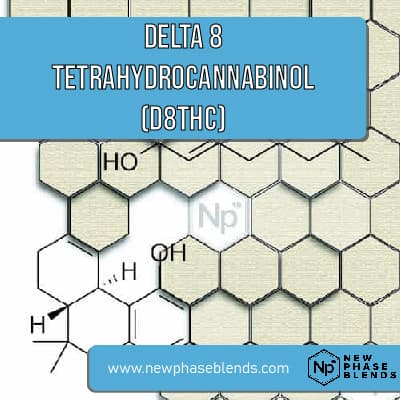
Delta-8-tetrahydrocannabinol (Δ8-THC) is a psychoactive cannabinoid found naturally in Cannabis sativa in trace amounts. It is an isomer of Δ9-THC — chemically identical in molecular formula (C₂₁H₃₀O₂) but differing in the position of a double bond within the cyclohexene ring: at carbon 8 in Δ8-THC versus carbon 9 in Δ9-THC. This positional difference, small as it sounds, produces measurably different receptor affinity and a generally less potent psychoactive effect (Tagen & Klumpers, 2022).
While delta-8 occurs naturally in cannabis, it does so in such small quantities that extraction for commercial use is not practical. Virtually all Δ8-THC on the consumer market is synthetically derived from CBD through a chemical isomerization process — an important point that distinguishes it from directly extracted natural cannabinoids and raises quality-control concerns unique to this production pathway (Ujváry, 2021; Ledvina et al., 2023).
CAS Number: 5957-75-5
Molecular Formula: C₂₁H₃₀O₂ (identical to Δ9-THC)
Double bond position: 8th carbon (vs. 9th in Δ9-THC)
Psychoactive: Yes — approximately half the potency of Δ9-THC
Natural abundance: Trace; most commercial supply is synthetically derived from CBD
Legal status (US): Gray area — federally permitted from hemp under the 2018 Farm Bill, but banned by several states
FDA-approved: No
Pharmacology: How Δ8-THC Works
Like Δ9-THC, delta-8 is a partial agonist at both CB1 and CB2 cannabinoid receptors. CB1 receptor activation in the central nervous system produces the psychoactive effects; CB2 receptor activity contributes to peripheral anti-inflammatory effects. Studies consistently show that Δ8-THC has lower binding affinity and potency at CB1 than Δ9-THC — generally estimated at approximately half the potency in most measures of biological activity (Tagen & Klumpers, 2022; Wikipedia contributors, 2025).
Following oral ingestion, Δ8-THC undergoes hepatic metabolism via cytochrome P450 enzymes (CYP2C9 and CYP3A4) to form 11-hydroxy-Δ8-THC, which is subsequently converted to 11-nor-Δ8-THC-9-carboxylic acid and excreted in urine after glucuronidation — a metabolic pathway closely paralleling that of Δ9-THC, with the key difference that 11-OH-Δ8-THC (the active first-pass metabolite) may be somewhat less potent than its Δ9-THC counterpart, contributing to delta-8’s milder oral experience (Wikipedia contributors, 2025).
Delta-8 vs. Delta-9: How Different Are They?
| Property | Δ8-THC | Δ9-THC |
|---|---|---|
| Double bond position | 8th carbon | 9th carbon |
| CB1 receptor affinity | Lower | Higher |
| Relative potency vs Δ9-THC | ~50% (estimated) | Reference standard |
| Psychoactive effects | Yes — milder, less anxious (self-report) | Yes — stronger |
| Anxiety/paranoia risk | Lower (reported) | Higher at large doses |
| Chemical stability | More stable than Δ9-THC | Less stable |
| Natural abundance in cannabis | Trace (<1%) | Major (5–30%+ in high-potency strains) |
| Commercial source | Primarily synthetic (from CBD) | Plant extraction or synthesis |
| FDA approval | No | Yes (Dronabinol/Marinol) |
A 2022 survey of 252 American delta-8 users found that users perceived it as less beneficial for chronic pain, anxiety, and stress than Δ9-THC, but also reported fewer or milder adverse effects including less anxiety, paranoia, and memory problems. Users who were familiar with CBD considered delta-8 more beneficial than CBD but with more adverse effects (Centre for Medicinal Cannabis Research, 2023).
What the Research Actually Says
Antiemetic Effects — Most Established Clinical Data
The most compelling clinical data for Δ8-THC is a small but landmark 1995 study by Abrahamov, Abrahamov, and Mechoulam that evaluated Δ8-THC as an antiemetic in eight children with hematologic malignancies undergoing chemotherapy. Dosing at 18 mg/m² every 6 hours was reported to almost completely prevent vomiting across all 480 treatment sessions. Side effects occurred in only two of eight children and were mild — irritability and euphoria. The authors concluded that Δ8-THC was a highly effective antiemetic with negligible psychotropic effects at the tested doses in this pediatric population (Abrahamov et al., 1995, as cited in Tagen & Klumpers, 2022).
This remains one of the most frequently cited pieces of Δ8-THC research, but it should be interpreted cautiously given the small sample size and the age of the data.
Psychoactive Effects — Confirmed But Milder
A comprehensive 2022 review in the British Journal of Pharmacology by Tagen and Klumpers — examining all available Δ8-THC literature including seven human studies — concluded that Δ8-THC clearly produces psychoactive effects similar in character to Δ9-THC, but is significantly less potent across all routes of administration. Psychiatric effects observed include euphoria, anxiety, loquaciousness, lowered inhibitions, hunger, a “high” feeling, and drowsiness — essentially the same qualitative profile as Δ9-THC at a lower intensity (Tagen & Klumpers, 2022).
Anxiolytic, Analgesic, and Other Potential Benefits
Preclinical research has suggested Δ8-THC may possess anxiolytic, analgesic, and neuroprotective properties analogous to Δ9-THC, along with anti-inflammatory effects through CB2 activity. However, human clinical data beyond the antiemetic study is essentially absent. The compound’s therapeutic potential remains significantly understudied relative to its surge in consumer popularity (Ledvina et al., 2023; Cannaspecialists, 2025).
Safety Concerns and Regulatory Issues
The safety picture for Δ8-THC consumer products is substantially clouded by the fact that most commercial supply is synthetically derived via chemical conversion of CBD — a process that, if conducted without proper pharmaceutical-grade controls, can leave behind residual solvents, acid catalysts, and byproducts including unidentified synthetic cannabinoid analogs (Ujváry, 2021; Ledvina et al., 2023).
The FDA received over 100 adverse event reports related to Δ8-THC products between December 2020 and February 2022 — 55% of which required medical intervention including evaluation by emergency services or hospitalization. Reported effects included hallucinations, vomiting, tremors, anxiety, dizziness, and loss of consciousness. Critically, because these products are not FDA-approved or regulated, it is impossible to definitively attribute adverse effects to Δ8-THC itself versus contaminants or incorrect dosing (Ledvina et al., 2023; Cannaspecialists, 2025).
Legal Status
The legal status of Δ8-THC in the United States is genuinely complex and continues to evolve. Following the 2018 Farm Bill, hemp-derived cannabinoids became federally legal as long as they contained less than 0.3% Δ9-THC. Delta-8 producers argued that synthetically converted hemp-derived Δ8-THC fell under this provision. The DEA’s 2020 Interim Final Rule added complexity by addressing synthetic cannabinoids, and ongoing litigation has produced conflicting rulings.
As of 2024, a significant and growing number of U.S. states have explicitly banned or restricted Δ8-THC products through state-level regulations (Cannaspecialists, 2025). Anyone considering delta-8 products should check their state’s specific laws before purchasing.
Frequently Asked Questions
Is delta-8-THC natural or synthetic?
Both. Δ8-THC occurs naturally in cannabis in trace amounts. However, essentially all commercial delta-8 products are made by chemically converting hemp-derived CBD via acid-catalyzed isomerization — a synthetic process. The end molecule is identical to natural Δ8-THC, but the production method introduces quality-control concerns not present in plant-extracted cannabinoids (Ledvina et al., 2023).
Will delta-8-THC show up on a drug test?
Yes. Standard drug tests screen for THC metabolites, and Δ8-THC produces metabolites (including Δ8-THC-COOH) that will trigger a positive result on standard urine immunoassay tests. If drug testing is a concern, avoiding all THC isomers including delta-8 is advisable (Wikipedia contributors, 2025).
Is delta-8-THC safer than delta-9-THC?
In terms of direct pharmacological effects at equivalent doses, Δ8-THC is generally considered less potent than Δ9-THC with a lower anxiety and paranoia profile. However, safety of commercial delta-8 products is complicated by unregulated manufacturing, potential contaminants, and mislabeling. The FDA has flagged Δ8-THC products as a significant consumer safety concern (Ledvina et al., 2023; Tagen & Klumpers, 2022).
Is delta-8-THC legal everywhere in the US?
No. Despite the federal gray area created by the 2018 Farm Bill, multiple U.S. states have banned or restricted delta-8-THC products. Federal legal status itself remains contested. Anyone in the US should check their specific state laws before purchasing or using delta-8 products (Cannaspecialists, 2025).
The Bottom Line
Delta-8-THC is a real, pharmacologically active cannabinoid with a genuine (if thin) scientific history and an interesting pharmacological profile — less potent than Δ9-THC, potentially less anxiety-inducing, and with a promising antiemetic signal in pediatric oncology. The 2022 comparative review by Tagen and Klumpers provides the most rigorous summary of the available data and is a worthy benchmark for understanding what is actually established.
What is equally real is that the commercial delta-8 market has exploded faster than the science can support it, that most products are synthetically derived, that quality control is largely absent, and that the FDA has raised legitimate safety alarms. The honest answer to “is delta-8 safe and effective?” is: it may be both, in the right context and at the right doses — but the consumer market is not that context.
Nothing in this article constitutes medical advice. Always consult a qualified healthcare provider before making any decisions about supplementation or treatment.
References
- Cannaspecialists. (2025). What clinicians need to know: Delta-8 tetrahydrocannabinol (THC). https://www.cannaspecialists.org/what_clinicians_need_to_know_about_delta_8_thc
- Centre for Medicinal Cannabis Research, McMaster University. (2023). What is delta-8-tetrahydrocannabinol (delta-8 THC)? https://cannabisresearch.mcmaster.ca/what-is-delta-8-tetrahydrocannabinol-delta-8-thc/
- Ledvina, K. R., Suelzer, E., & El-Alfy, A. T. (2023). Delta-8-tetrahydrocannabinol: A phytocannabinoid on the rise. RPS Pharmacy and Pharmacology Reports, 2(3), rqad031. https://doi.org/10.1093/rpsppr/rqad031
- LoParco, C. R., Rossheim, M. E., Walters, S. T., Zhou, Z., Olsson, S., & Sussman, S. Y. (2023). Delta-8 tetrahydrocannabinol: A scoping review and commentary. Addiction, 118(6), 1011–1028. https://doi.org/10.1111/add.16142
- Tagen, M., & Klumpers, L. E. (2022). Review of delta-8-tetrahydrocannabinol (Δ8-THC): Comparative pharmacology with Δ9-THC. British Journal of Pharmacology, 179(15), 3915–3933. https://doi.org/10.1111/bph.15865
- Ujváry, I. (2021). Delta-8-tetrahydrocannabinol as a natural product: Chemistry and practical perspectives. Biomolecules, 11(6), 803. https://doi.org/10.3390/biom11060803
- Wikipedia contributors. (2025). Δ8-Tetrahydrocannabinol. Wikipedia, The Free Encyclopedia. https://en.wikipedia.org/wiki/%CE%948-Tetrahydrocannabinol


