
A Note Before We Start
Like several of the rare cannabinoids in this database, cannabigerovarinic acid (CBGVA) has been studied far more as a chemistry intermediate than as a pharmacological agent. There are no published clinical trials of CBGVA in humans, and direct in vivo work on the compound itself is sparse. Where the literature is rich is in describing CBGVA’s role as a biosynthetic precursor of the so-called “varin” cannabinoids — the propyl-side-chain cousins of THC, CBD, CBC, and their acidic precursors. This article focuses on what is actually documented in peer-reviewed sources, and is transparent about where the data thin out.
What Is CBGVA?
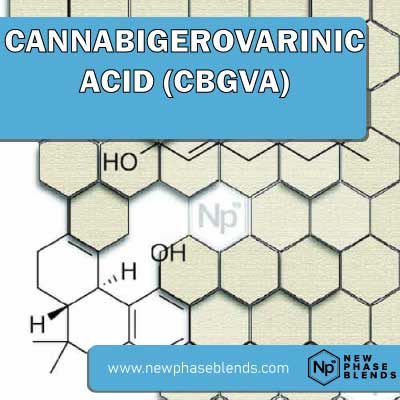
Cannabigerovarinic acid (CBGVA) is a minor cannabinoid acid found in Cannabis sativa. Structurally, it is the propyl-side-chain homolog of cannabigerolic acid (CBGA): the two compounds share the same overall scaffold, but CBGVA carries a three-carbon (propyl) alkyl chain in place of CBGA’s five-carbon (pentyl) chain (Hanuš et al., 2016; Pollastro et al., 2018).
That single structural difference is more important than it sounds. The propyl-chain length defines an entire parallel branch of cannabinoid biosynthesis — the “varin” series — which gives rise to tetrahydrocannabivarinic acid (THCVA), cannabidivarinic acid (CBDVA), and cannabichromevarinic acid (CBCVA) in the same way that CBGA gives rise to THCA, CBDA, and CBCA in the more familiar pentyl series (Hanuš et al., 2016).
Biosynthesis: Why CBGVA Is the Hub of the Varin Series
CBGVA’s biosynthetic origin parallels that of CBGA, with one important difference at the polyketide step:
1. Instead of the fatty-acid–derived precursor olivetolic acid (which feeds the pentyl-chain cannabinoids), the varin pathway uses divarinolic acid, the propyl analog (Hanuš et al., 2016). 2. The terpenoid intermediate geranyl pyrophosphate (GPP) then condenses with divarinolic acid through the action of an aromatic prenyltransferase — the same family of enzymes that produces CBGA from olivetolic acid (Page & Boubakir, 2014). 3. The product of that prenylation is CBGVA. 4. From CBGVA, the same three downstream enzymes that act on CBGA — THCA synthase, CBDA synthase, and CBCA synthase — can in principle act on CBGVA to produce the acidic forms of THCV, CBDV, and CBCV (Sirikantaramas et al., 2004; Taura et al., 2007). In vitro reconstitution work has confirmed that THCA synthase will accept CBGVA as a substrate and produce THCVA, which can then decarboxylate to THCV (Luo et al., 2019).
This central position in the varin series is the most important fact about CBGVA from a research perspective: when scientists or biotechnology companies want to produce THCV or CBDV through enzymatic or yeast-based biosynthesis, CBGVA is typically the intermediate they need to make first.
Pharmacology: Where the Literature Is Thin
The honest summary: there is essentially no pharmacological characterization of CBGVA itself in the peer-reviewed literature. As of the time of writing:
- No published in vivo studies have specifically tested CBGVA in animal models.
- No clinical trials have been conducted in humans.
- No detailed receptor- or channel-binding panels have been published for CBGVA. Affinity values for CB1, CB2, TRP channels, PPARs, and other relevant targets have been mapped for CBG and CBGA, but not for the propyl-chain CBGVA.
What exists is mostly inference. Some in vitro work on the neutral varin cannabinoid cannabigerovarin (CBGV) — the decarboxylated form of CBGVA — has explored interactions with cannabinoid receptors and skin-relevant targets (Pollastro et al., 2018), but the pharmacology of the acidic CBGVA cannot be assumed to mirror the neutral CBGV. Even modest structural changes between acid and neutral cannabinoids can substantially alter receptor and channel binding (D’Aniello et al., 2019; Mahmoudinoodezh et al., 2024).
For consumer-facing claims, this distinction matters. Statements that CBGVA produces specific physiological effects in humans are not supported by direct evidence. They are, at best, extrapolation from related cannabinoids and, at worst, marketing.
Why CBGVA Still Matters
Despite the lack of direct pharmacological data, CBGVA remains a meaningful research target for several reasons:
Biotechnological production of THCV and CBDV. Engineered microbial systems — for example, the yeast platforms described by Luo et al. (2019) — can produce CBGVA as an intermediate on the way to THCVA, CBDVA, and ultimately THCV and CBDV. As interest in propyl cannabinoids grows, so does interest in CBGVA as the entry point.
Chemotaxonomic marker. Detection of CBGVA in expanded analytical panels can help phytochemists distinguish cannabis chemovars rich in varin cannabinoids — particularly certain landrace lines from Southeast Asia and Southern Africa — from the more common pentyl-dominant chemovars (Hanuš et al., 2016).
Reference standard. Like other rare cannabinoid acids, CBGVA is sold as a high-purity chemical reference compound for use in HPLC and mass-spectrometry method development.
Stability and Handling
CBGVA, like all cannabinoid acids, is thermally and photochemically labile. Heat, ultraviolet light, and prolonged storage cause decarboxylation: the carboxyl group is lost as carbon dioxide and the molecule converts into its neutral form, cannabigerovarin (CBGV). Practically, this means that products labeled as CBGVA-rich must be stored cool and protected from light, and that smoked or vaporized cannabis containing CBGVA in the live plant will deliver primarily CBGV to the user.
Safety and Regulatory Status
There are no published clinical safety data on CBGVA. It is not a controlled substance in its own right in most jurisdictions, but is generally regulated under the broader cannabis-derived cannabinoid framework wherever cannabis is regulated. The U.S. Food and Drug Administration has not approved CBGVA for any therapeutic purpose.
Because no controlled human safety information exists, CBGVA-containing products should not be used by people who are pregnant, nursing, taking prescription medications, or managing a medical condition. Anyone considering products that list CBGVA among their cannabinoids should ask the manufacturer for a verified Certificate of Analysis and discuss use with a qualified medical professional.
Frequently Asked Questions
Is CBGVA the same as CBGA?
No. CBGA carries a five-carbon (pentyl) side chain and is the precursor to THCA, CBDA, and CBCA. CBGVA carries a three-carbon (propyl) side chain and is the precursor to THCVA, CBDVA, and CBCVA. They share a similar scaffold but generate parallel cannabinoid families with potentially different pharmacology.
Is CBGVA the same as CBGV?
No. CBGVA is the acidic (carboxylated) form; CBGV is the neutral (decarboxylated) form. Heat and time convert CBGVA into CBGV.
Does CBGVA cause intoxication?
No published study has reported intoxicating effects from CBGVA. In the absence of human data, this should be treated as an absence of evidence rather than evidence of safety.
Why is CBGVA studied if there’s so little pharmacology data?
Mostly because of its biosynthetic role. CBGVA is the metabolic gateway to the entire varin-cannabinoid family — including THCV and CBDV, which themselves are active research areas — so even when CBGVA itself is not the focus of a study, it is often the intermediate that scientists need to characterize and produce.
Important Disclaimer
The information in this article is for educational purposes only and is not medical advice. Statements about cannabigerovarinic acid (CBGVA) have not been evaluated by the U.S. Food and Drug Administration. Products containing CBGVA are not intended to diagnose, treat, cure, or prevent any disease. Always consult a licensed physician or qualified healthcare provider before starting any new supplement, particularly if you are pregnant, nursing, taking prescription medications, or managing a chronic medical condition.
References
D’Aniello, E., Fellous, T., Iannotti, F. A., Gentile, A., Allarà, M., Balestrieri, F., Gray, R., Amodeo, P., Vitale, R. M., & Di Marzo, V. (2019). Identification and characterization of phytocannabinoids as novel dual PPARα/γ agonists by a computational and in vitro experimental approach. Biochimica et Biophysica Acta (BBA) – General Subjects, 1863(3), 586–597. https://doi.org/10.1016/j.bbagen.2019.01.002
Hanuš, L. O., Meyer, S. M., Muñoz, E., Taglialatela-Scafati, O., & Appendino, G. (2016). Phytocannabinoids: A unified critical inventory. Natural Product Reports, 33(12), 1357–1392. https://doi.org/10.1039/C6NP00074F
Luo, X., Reiter, M. A., d’Espaux, L., Wong, J., Denby, C. M., Lechner, A., Zhang, Y., Grzybowski, A. T., Harth, S., Lin, W., Lee, H., Yu, C., Shin, J., Deng, K., Benites, V. T., Wang, G., Baidoo, E. E. K., Chen, Y., Dev, I., … Keasling, J. D. (2019). Complete biosynthesis of cannabinoids and their unnatural analogues in yeast. Nature, 567(7746), 123–126. https://doi.org/10.1038/s41586-019-0978-9
Mahmoudinoodezh, H., Telek, A., Brych, M., Wagner, M., Saliba, A. N., Schweigel-Röntgen, M., Krüger, J., Yew, K. K., Kirschner, J. P., Eickholt, B. J., & Zierler, S. (2024). Cannabigerolic acid (CBGA) inhibits the TRPM7 ion channel through its kinase domain. Function, 5(1), zqad069. https://doi.org/10.1093/function/zqad069
Page, J. E., & Boubakir, Z. (2014). Aromatic prenyltransferase from Cannabis (U.S. Patent No. 8,884,100). U.S. Patent and Trademark Office.
Pollastro, F., Caprioglio, D., Del Prete, D., Rogati, F., Minassi, A., Taglialatela-Scafati, O., Munoz, E., & Appendino, G. (2018). Cannabichromene. Natural Product Communications, 13(9), 1189–1194.
Sirikantaramas, S., Morimoto, S., Shoyama, Y., Ishikawa, Y., Wada, Y., Shoyama, Y., & Taura, F. (2004). The gene controlling marijuana psychoactivity: Molecular cloning and heterologous expression of Δ¹-tetrahydrocannabinolic acid synthase from Cannabis sativa L. Journal of Biological Chemistry, 279(38), 39767–39774. https://doi.org/10.1074/jbc.M403693200
Taura, F., Sirikantaramas, S., Shoyama, Y., Yoshikai, K., Shoyama, Y., & Morimoto, S. (2007). Cannabidiolic-acid synthase, the chemotype-determining enzyme in the fiber-type Cannabis sativa. FEBS Letters, 581(16), 2929–2934. https://doi.org/10.1016/j.febslet.2007.05.043


