
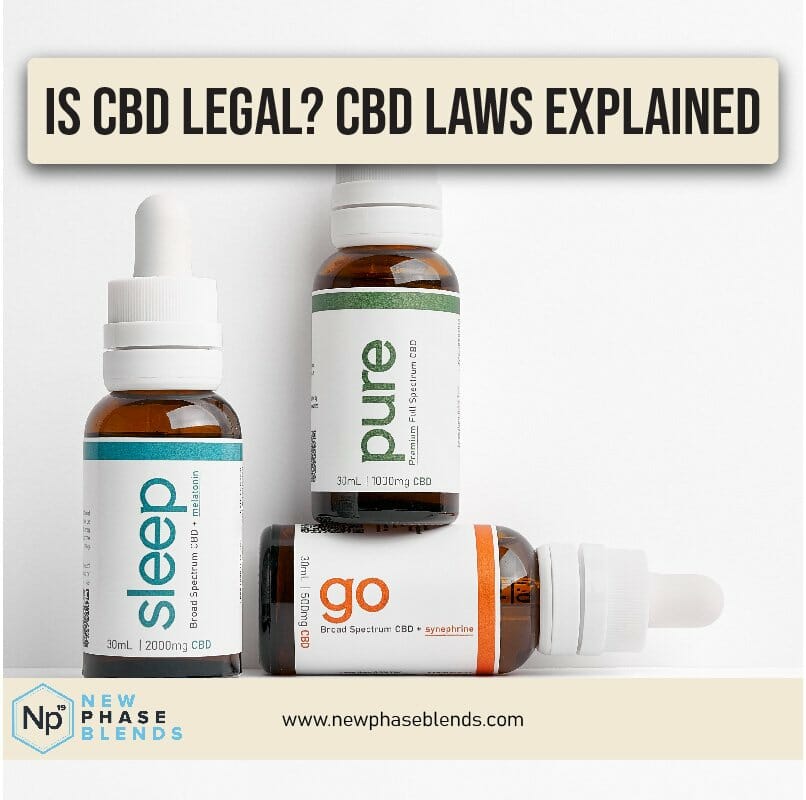
TL;DR – Yes, CBD oil derived from hemp is federally legal in the United States. The 2018 Farm Bill removed hemp (cannabis with no more than 0.3% delta-9 THC) from the federal Controlled Substances Act, making hemp-derived CBD products legal to produce, sell, and possess nationwide. Most states have aligned with this federal framework, though some state-level variations apply. No prescription is required to purchase hemp CBD oil.
The Short Answer: Hemp-Derived CBD Oil Is Federally Legal
If you have been wondering whether CBD oil is legal in the United States, the answer is yes — with an important qualifier. The legality of CBD oil depends on where it comes from. CBD oil derived from hemp, defined as cannabis containing no more than 0.3% delta-9 tetrahydrocannabinol (THC) on a dry weight basis, is federally legal under the Agricultural Improvement Act of 2018, also known as the 2018 Farm Bill. CBD oil derived from marijuana — cannabis exceeding the 0.3% THC threshold — remains a Schedule I controlled substance under federal law.
For the vast majority of CBD oils sold in retail stores, wellness shops, and online, the source is hemp. These products are fully legal at the federal level and available without a prescription, medical card, or any other special authorization in most of the country.
How the 2018 Farm Bill Changed Everything
To understand why hemp CBD oil is now legal, you need to understand what changed in 2018. Prior to the passage of the Agricultural Improvement Act of 2018 (Pub. L. No. 115-334), hemp had been treated the same as marijuana under the Controlled Substances Act of 1970. That law made no meaningful distinction between industrial hemp and marijuana — any cannabis plant was considered a Schedule I controlled substance regardless of its THC content.
This created a paradox. Hemp had been grown for centuries for fiber, textiles, rope, and seeds, and it was historically important in American agriculture. Yet the 1970 Act effectively banned its cultivation and commerce. A limited exception was created by the Agricultural Act of 2014, which permitted hemp pilot programs for research at universities and state agricultural departments. But commercial production and interstate commerce in hemp products remained legally questionable.
The 2018 Farm Bill resolved this. By amending the Controlled Substances Act to explicitly exclude hemp from the definition of marijuana, Congress created a clear federal legal status for hemp and hemp-derived products. The law also required the USDA to establish a national hemp production program and permitted states to operate their own USDA-approved hemp programs. Importantly, it explicitly legalized the interstate transport of hemp and hemp derivatives, which was essential for creating a functioning national market.
The Federal Definition of Hemp and CBD
Under 7 U.S.C. § 1639o, hemp is defined as the plant Cannabis sativa L. and any part of that plant, including its seeds, derivatives, extracts, cannabinoids, isomers, acids, salts, and salts of isomers, with a delta-9 THC concentration of no more than 0.3% on a dry weight basis. This definition is important because CBD (cannabidiol) is a cannabinoid — a naturally occurring compound in the cannabis plant. When it is derived from hemp meeting this definition, CBD itself is legal under federal law.
The DEA updated its regulations to reflect the 2018 Farm Bill. The agency’s position, clarified in its August 2020 interim final rule (85 Fed. Reg. 51639), is that hemp-derived cannabinoids including CBD are not controlled substances under the Controlled Substances Act, provided the delta-9 THC content does not exceed the 0.3% threshold at any point in the production process.
This means that compliant hemp CBD oil — oil extracted from hemp and containing no more than 0.3% delta-9 THC — is legal to produce, transport, sell, and possess at the federal level. It is not a drug, a controlled substance, or a prescription medication in its hemp-derived form.
FDA Authority Over CBD in Food and Supplements
The 2018 Farm Bill clarified the DEA and Controlled Substances Act questions about hemp CBD, but it preserved the FDA’s authority to regulate CBD in food, dietary supplements, and drug products. The FDA has taken the position that CBD cannot legally be added to food or sold as a dietary supplement because it was approved as a drug ingredient (in the form of Epidiolex) before any hemp-derived CBD product was marketed as a supplement.
Epidiolex is a pharmaceutical CBD product approved by the FDA in 2018 for the treatment of certain severe seizure disorders. It is a prescription medication distinct from over-the-counter hemp CBD products. Its existence has complicated the FDA’s regulatory pathway for supplement-grade CBD, as federal law generally prohibits marketing a drug ingredient as a food or dietary supplement.
In practice, the FDA has taken a restrained enforcement approach. The agency has not moved to ban the sale of hemp CBD supplements and has instead focused its enforcement resources on companies making disease treatment claims (such as claiming CBD cures cancer or treats chronic conditions) and on products with significant safety profiles. Millions of people purchase hemp CBD oils, tinctures, gummies, and capsules throughout the country without legal concern. However, the regulatory framework is genuinely unsettled, and a more comprehensive FDA rulemaking could change the market landscape at some point.
State Laws: What Varies and What Stays the Same
Federal legality does not mean every state treats hemp CBD identically. The large majority of states have aligned with the federal definition and operate their own hemp programs under USDA approval. In these states — which constitute the overwhelming majority — hemp CBD oil is available in stores and online without restriction.
A small number of states have historically maintained additional restrictions on CBD or specific hemp cannabinoids. Idaho, for example, requires hemp products to contain absolutely zero detectable THC, which is stricter than the federal 0.3% threshold. Some states have moved to regulate or restrict delta-8 THC and similar cannabinoids separately from CBD. If you live in or are traveling to a state where you are unsure about CBD law, it is worth verifying the current state-level rules before purchasing or traveling with CBD products.
What Makes a CBD Oil Legally Compliant
For a CBD oil to be compliant with federal law, it must meet the following criteria: it must be derived from hemp — Cannabis sativa L. with no more than 0.3% delta-9 THC; the hemp must have been grown by a licensed cultivator under an approved state or federal hemp program; and the product itself must not exceed the 0.3% delta-9 THC threshold at any point in processing or in final form.
Responsible manufacturers verify compliance through third-party laboratory testing. The test results, documented in a Certificate of Analysis (COA), show the cannabinoid profile of the product including CBD content and delta-9 THC levels. A proper COA also tests for contaminants such as heavy metals, pesticides, residual solvents, and microbial matter. When you buy a CBD oil, the most important thing to verify is that the product comes with a current, third-party COA from an ISO-accredited laboratory.
New Phase Blends publishes COAs for all of its products, making it easy to confirm compliance and verify potency. This level of transparency is a meaningful differentiator in a market that still contains products of variable quality and unclear sourcing.
Types of CBD Oil and What They Mean
When shopping for CBD oil, you will encounter three primary product types. Full-spectrum CBD oil contains all the naturally occurring cannabinoids found in hemp, including trace amounts of THC (within the 0.3% legal limit), as well as terpenes and other beneficial plant compounds. Many users prefer full-spectrum products because of the potential synergistic effects of these compounds, sometimes called the entourage effect.
Broad-spectrum CBD oil contains multiple cannabinoids and terpenes but has had the THC removed or reduced to non-detectable levels. This is a good option for people who want the potential benefits of multiple cannabinoids but are concerned about THC appearing on a drug test or simply prefer a THC-free product.
CBD isolate is pure CBD in crystalline powder form, with all other plant compounds removed. Isolate products are definitively THC-free and are commonly used to produce other CBD products or for people who want only CBD with no other cannabinoids or terpenes.
Buying CBD Oil: What to Look For
The hemp CBD market has matured considerably since 2018, but product quality still varies significantly between brands. When purchasing CBD oil, you should look for brands that clearly state the hemp source and whether it is domestically grown, provide a Certificate of Analysis from a third-party laboratory for each product batch, accurately label the CBD content per serving and per bottle, avoid making disease treatment claims, and have a clear and responsive customer service presence.
Price is not a reliable indicator of quality. Some expensive products are not third-party tested, while reputable brands offer well-priced products with full transparency. The COA is the most objective measure of product compliance and quality regardless of where the hemp was grown.
Frequently Asked Questions About CBD Oil Legality
Can I travel on a plane with CBD oil?
Yes. TSA guidelines permit passengers to carry hemp-derived CBD products containing no more than 0.3% THC in both carry-on and checked baggage. Keeping the product in its original packaging and having access to the COA is a practical precaution. If traveling internationally, research the laws of your destination country, as CBD oil is not legal everywhere.
Will hemp CBD oil show up on a drug test?
Standard drug tests screen for THC metabolites. Full-spectrum CBD oil contains trace THC, and in some cases regular or heavy use could lead to a positive test result. If drug testing is a concern, broad-spectrum or CBD isolate products with non-detectable THC are a safer choice. Verify with the product’s COA that THC is below the detection threshold.
Is CBD oil legal in all 50 states?
Hemp-derived CBD oil is federally legal and legal in the vast majority of states. A small number of states have historically had additional restrictions, and some states regulate specific cannabinoids differently. The state-by-state table below gives a full overview of each state’s status and links to official resources.
Do I need a doctor’s prescription to buy CBD oil?
No. Hemp-derived CBD oil is not a prescription medication and is available over the counter at retail stores, wellness shops, and online throughout the country. The prescription CBD medication Epidiolex is a separate pharmaceutical product unrelated to retail hemp CBD products.
How much CBD should I take?
Serving sizes and individual responses to CBD vary considerably. Most hemp CBD products recommend starting with a lower serving and adjusting based on your experience. Because CBD is not a prescription drug, the FDA has not established official dosing guidelines for hemp CBD products. Speaking with a healthcare provider familiar with hemp-derived cannabinoids is the most reliable way to get guidance tailored to your situation.
CBD Laws By State
The following table summarizes the current legal status of hemp-derived CBD in all 50 states plus Washington, D.C., and links to each state’s official hemp or CBD regulatory program for more detailed information. All entries reflect hemp-derived CBD containing no more than 0.3% delta-9 THC unless otherwise noted.
References
Agricultural Improvement Act of 2018, Pub. L. No. 115-334, 7 U.S.C. § 1639o (2018). Hemp farming. https://www.congress.gov/bill/115th-congress/house-bill/2
Controlled Substances Act, 21 U.S.C. § 801 et seq. (1970). Federal controlled substances schedules. https://www.dea.gov/drug-information/csa
U.S. Drug Enforcement Administration. (2020). Implementation of the Agriculture Improvement Act of 2018. 85 Fed. Reg. 51639. https://www.federalregister.gov/documents/2020/08/21/2020-17356/implementation-of-the-agriculture-improvement-act-of-2018
U.S. Food and Drug Administration. (2023). FDA regulation of cannabis and cannabis-derived products, including cannabidiol (CBD). https://www.fda.gov/news-events/public-health-focus/fda-regulation-cannabis-and-cannabis-derived-products-including-cannabidiol-cbd
U.S. Department of Agriculture. (2021). Hemp production program. https://www.ams.usda.gov/rules-regulations/hemp


